|
Basic Specifications
|
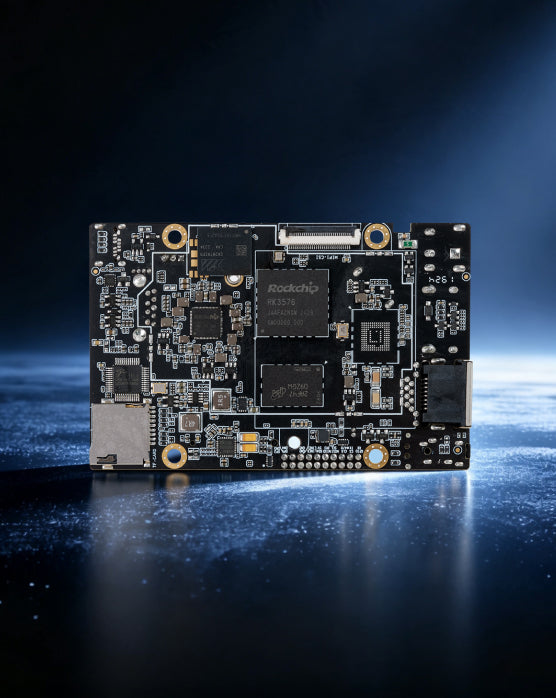
SOC
|
CAM-3576Q38: Rockchip RK3576 CAM-3576JQ38: Rockchip RK3576J CAM-3576MQ38: Rockchip RK3576M |
|---|
|
CPU
|
CAM-3576Q38: Octa-core 64-bit processor (4×A72 + 4×A53) with a maximum frequency of 2.2GHz CAM-3576JQ38/3576MQ38: Octa-core 64-bit processor (4×A72 + 4×A53) with a maximum frequency of 1.6GHz |
|---|
|
GPU
|
G52 MC3@1GHz, support OpenGL ES 1.1/2.0/3.2, OpenCL 2.0, Vulkan 1.1, embedded with high-performance 2D acceleration hardware |
|---|
|
ISP
|
Built-in 16 million pixel ISP, support low-light noise reduction, support RGB-IR sensor, support up to 120dB HDR, AI-ISP to improve low-noise image effect |
|---|
|
NPU
|
6 TOPS NPU, It supports INT4/INT8/INT16/FP16/BF16/TF32 operations, supports dual-core collaborative or independent work, and supports multi-task and multi-scene parallelism |
|---|
|
AI performance
|
Support the privatization deployment of ultra-large-scale parametric models under the Transformer architecture, such as Gemma series, ChatGLM series, Qwen series, Phi series and other large language models
It supports traditional network architectures such as CNN, RNN, and LSTM, and supports the import and export of RKNN models; Support a variety of deep learning frameworks, including TensorFlow, TensorFlow Lite, PyTorch, Caffe, ONNX and Darknet. It also supports the development of custom operators
Support Docker container management technology
It supports the real-time object detection algorithm YOLO (You Only Look Once), which is fast and real-time compared with traditional object detection methods, and can accurately identify and locate multiple target objects in images or videos, powering AI applications |
|---|
|
Decoding/ Encoding
|
Decoding: 8K@30fps/4K@120fps (VP9, AVS2, AV1), 4K@60fps (H.264/AVC)
Encoding: 4K@60fps (H.264/AVC)
Image codec: 4K@60fps MJPG |
|---|
|
RAM
|
LPDDR4/LPDDR4x/LPDDR5 (4GB/8GB/16GB optional) |
|---|
|
Storage
|
eMMC (16GB/32GB/64GB/128GB/256GB optional) |
|---|
|
Storage expansion
|
|
|---|
|
OS
|
It supports RTLinux kernel and has excellent real-time performance, which is widely used in industrial application scenarios. Support Linux OS, Buildroot, and provide a safe and stable system environment for product research and production. It has new industrial features such as real-time network, Flexbus, hardware resource isolation, and DSMC to meet the needs of different industrial applications. |
|---|
|
Power
|
DC 12V (Connected via 8P-1.25mm Wafer connector) |
|---|
|
Dimension
|
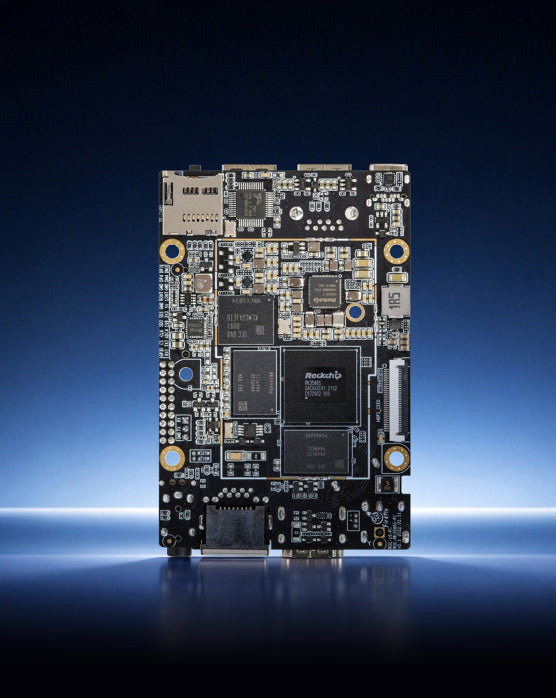
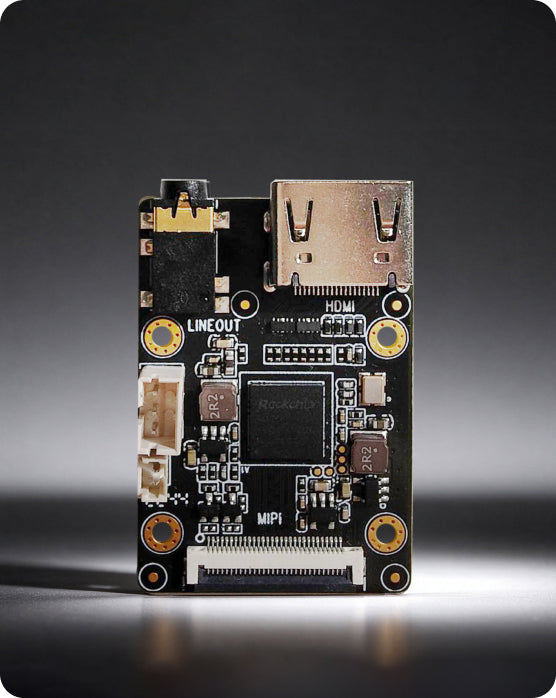
38.09mm × 38.11mm × 11.54mm |
|---|
|
Weight
|
|
|---|
|
Environment
|
CAM-3576Q38: Operating Temperature: -20℃~60℃, Storage Humidity: 10%~90%RH (non-condensing) CAM-3576JQ38/3576MQ38: Operating temperature: -40℃~85℃, Operating humidity: 10%~90%RH (non-condensing) |
|---|
|
Interface Specifications
|
Ethernet
|
1 × 100M Ethernet (Led out via 8P-1.25mm Wafer connector)
|
|---|
|
Wireless network
|
1 WiFi module on board, supporting 2.4GHz/5GHz dual-band WiFi6 (802.11a/b/g/n/ac/ax) |
|---|
|
Video input
|
4 × MIPI-CSI DPHY (Supports MIPI V1.2 version; 1×4Lanes, 40Pin-0.5mm) |
|---|
|
Audio output
|
1 × MIC (2Pin-1.25mm), 1 × Speaker (4Pin-1.25mm, 2×10W/6Ω or 2×10W/8Ω) |
|---|
|
USB
|
1 × USB2.0 (Led out via 24Pin-0.5mm FPC connector), 1 × Type-C (Device) |
|---|
|
Antenna
|
|
|---|
|
Button
|
|
|---|
|
Other interfaces
|
1 × Expansion Interface (24Pin-0.5mm FPC connector, led out: 5V, 1×USB2.0, 1×ADC, 1×I2C, 1×UART, 10×GPIO), 1 × RS485 (Led out via 8P-1.25mm Wafer connector), 1 × RTC Battery Holder (2Pin-1.25mm), 1 × Debug (3Pin-1.25mm), 1 × Recovery (2Pin-1.25mm) |
|---|






























 Al Processor RK3576
 Private Deployment
 8K Viede Decoding
 Built-in 16-megapixel ISP
 38 x 38mm mini size
 Multiple Operating Systems
 Rich Expansion Interfaces
 Development Materials


